

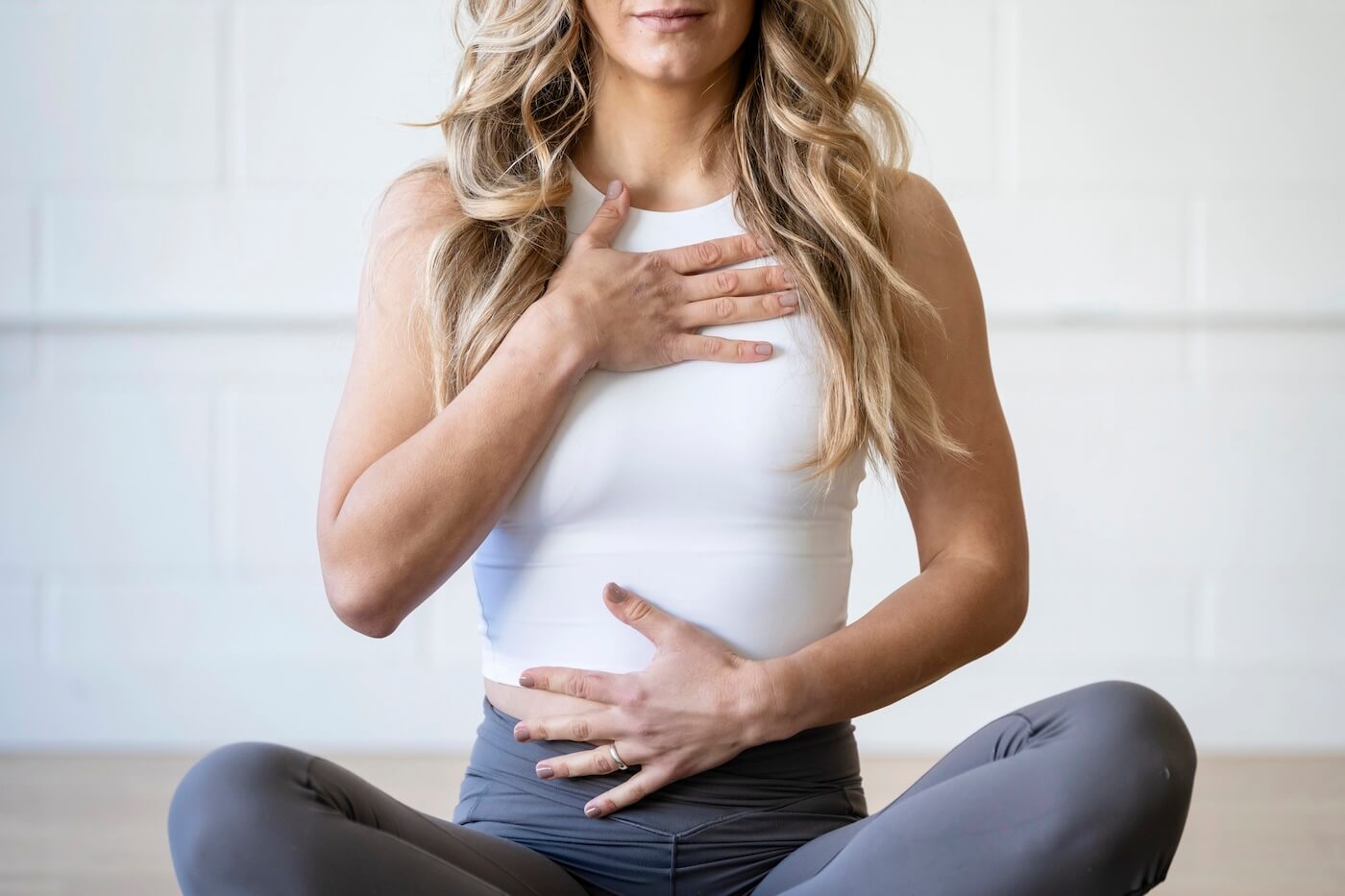
If you’ve ever been told to “just breathe,” you probably brushed it off as a simple relaxation cue. You may have wondered how something so basic could possibly help with pain, pelvic tension, leaking, or core weakness. But breathwork, real intentional diaphragmatic breathwork, is far more powerful than most people realize.
At Breakaway Physical Therapy, we talk about breathwork every single day because it directly affects:
- ✓ Pain and sensitivity
- ✓ Pelvic floor tension and coordination
- ✓ Core strength and deep core activation
- ✓ Posture and alignment
- ✓ Mobility
- ✓ Stress and nervous system regulation
- ✓ Sleep
- ✓ Digestion
- ✓ Overall pelvic health and physical function
Breathing is something you do all day without thinking. When you learn how to do it well, it becomes one of the strongest and most accessible tools you have for pelvic floor health, pain relief, and core stability.
In this blog, we will walk you through why breathwork is essential, how it supports pelvic floor function, how it builds core strength from the inside out, and the breathing exercises we teach at Breakaway to help you feel better, move better, and heal more naturally.
Let’s dive in.
Why Breathwork Matters More Than You Think
You take roughly 20,000 breaths each day. That means your breathing pattern, whether helpful or harmful, repeats thousands of times. If your pattern is:
- ✓ Shallow
- ✓ Tight
- ✓ Rushed
- ✓ Mostly in your chest
- ✓ Connected to stress
- ✓ Disconnected from your core
…your system stays on high alert. Your pelvic floor tightens, your back and neck muscles overwork, and your pain system becomes more sensitive. Many people rely on accessory breathing muscles that are not meant to work this hard, and this leads to pain and pelvic floor dysfunction.
Diaphragmatic breathing does the opposite. It calms the nervous system, strengthens the core, improves movement, and allows the pelvic floor to function the way it is meant to. Breath is the foundation of almost everything your body does.
How Breathwork Impacts Pain
Many people ask, “How does something as simple as breathing change pain?” Here’s why it works.
1. Breathing Regulates Your Nervous System
Pain is not only about muscles or joints. It is also about how the nervous system interprets signals. Shallow or rapid breathing tells your body there is a threat. This can:
- ✓ Amplify pain
- ✓ Increase muscle guarding
- ✓ Limit mobility
- ✓ Heighten sensitivity
Diaphragmatic breathing signals safety. When your brain feels safe, your body naturally:
- ✓ Relaxes
- ✓ Releases tension
- ✓ Reduces pain signals
- ✓ Moves more easily
This is why people often feel immediate relief when they learn how to breathe deeply.
2. Breathwork Improves Circulation and Oxygen Flow
Tight muscles are often oxygen deprived. When you expand your ribs and diaphragm through breathwork, you increase circulation. This helps:
- ✓ Reduce muscle knots
- ✓ Improve tissue healing
- ✓ Enhance movement quality
3. Breathing Lowers Stress Hormones
Controlled breathing lowers cortisol. When stress decreases, pain naturally decreases.
4. Breathwork Reduces Muscle Guarding
People with chronic pain often carry tension in their:
- ✓ Neck
- ✓ Shoulders
- ✓ Jaw
- ✓ Lower back
- ✓ Pelvic floor
Breathing is one of the most effective ways to reduce this guarding.
How Breathwork Improves Pelvic Health
Breathwork is essential for pelvic floor health. Your diaphragm and pelvic floor are deeply connected. They move together like a piston.
- ✓ During an inhale, the diaphragm lowers and the pelvic floor lengthens.
- ✓ During an exhale, the diaphragm lifts and the pelvic floor recoils and engages.
When your breathing pattern is off, the pelvic floor can become:
- ✓ Too tight
- ✓ Too weak
- ✓ Overworked
- ✓ Uncoordinated
This often leads to:
- ✓ Urinary leaking
- ✓ Pelvic pain
- ✓ Prolapse symptoms
- ✓ Low back pain
- ✓ Pain with intercourse
- ✓ Constipation
- ✓ Core weakness
Understanding this connection helps explain why breathwork is one of the most powerful pelvic floor physical therapy tools.
1. Breathing Teaches the Pelvic Floor to Relax
Many people think pelvic floor dysfunction means weakness. In reality, tightness is often the bigger issue. Breathwork teaches your pelvic floor to soften, lengthen, and let go so it can work properly.
2. Breathing Helps With Pressure Management
If you hold your breath during lifting, pushing, or even getting out of bed, internal pressure increases. This can worsen:
- ✓ Leaking
- ✓ Prolapse
- ✓ Hernias
- ✓ Core separation
Breathwork teaches your body to manage pressure so the pelvic floor is protected.
3. Breathing Improves Alignment
The pelvic floor functions best when the ribs are stacked over the pelvis. Diaphragmatic breathing naturally improves alignment by:
- ✓ Expanding the rib cage
- ✓ Reducing shoulder tension
- ✓ Improving posture
- ✓ Supporting core engagement
4. Breathing Creates Natural Pelvic Floor Strength
When you exhale, the deep core and pelvic floor engage together. This builds real, functional pelvic floor strength.
How Breathwork Strengthens the Core
Your core is more than your abs. It includes:
- ✓ The diaphragm
- ✓ The pelvic floor
- ✓ The transverse abdominis
- ✓ The multifidus
These muscles work as a team. If one part is not functioning, the whole system struggles.
1. Breathwork Activates the Deep Core Automatically
On the exhale, your deep core turns on without straining or gripping. This leads to:
- ✓ Better spinal support
- ✓ Reduced back pain
- ✓ More efficient movement
2. Breathwork Prevents Breath Holding
People often hold their breath while lifting, standing up, carrying groceries, or even picking up kids. This increases pressure and reduces stability. Breathwork keeps the core active and supportive.
3. Breathwork Improves Rib Mobility
Stiff ribs limit core strength. When breathing expands the ribs in a full 360 pattern, it improves:
- ✓ Spinal mobility
- ✓ Balance
- ✓ Postural control
- ✓ Core coordination
4. Breath Paired With Exercise Makes the Core Stronger
Simple cues like “exhale as you move” transform exercises such as:
- ✓ Dead bugs
- ✓ Bridges
- ✓ Planks
- ✓ Squats
Small changes make a big difference.
Signs You May Need Breathwork
You may benefit from breathwork if any of these sound familiar:
- ✓ You breathe mostly into your chest
- ✓ Your shoulders rise with every inhale
- ✓ You hold your breath during movement
- ✓ You leak urine during exercise
- ✓ You feel pelvic heaviness
- ✓ Your ribs flare forward
- ✓ Your core feels weak or disconnected
- ✓ Your jaw or neck are always tight
- ✓ You struggle to relax
These patterns often signal pelvic floor dysfunction, core instability, or nervous system imbalance.
Breathwork Exercises You Can Try Today
These are some of the techniques we teach in the clinic.
1. 360 Degree Breathing
How to do it:
- ➤ Sit or lie comfortably.
- ➤ Place your hands on your lower ribs.
- ➤ Inhale and expand the rib cage in every direction.
- ➤ Exhale slowly.
Goal: Expand into the belly, sides, and back.
2. Pelvic Floor Drop Breathing
How to do it:
- ➤ Sit or lie with knees bent.
- ➤ Inhale and imagine the pelvic floor softening and widening.
- ➤ Exhale and let it gently recoil.
Goal: Learn to relax pelvic floor muscles naturally.
3. Core Connection Breathing
How to do it:
- ➤ Inhale to prepare.
- ➤ Exhale and gently activate your deep core.
Goal: Build deep core control without gripping.
4. Extended Exhale Breathing
How to do it:
- ➤ Inhale for a count of four.
- ➤ Exhale for a count of six or eight.
Goal: Reduce pain and calm the nervous system.
When Breathwork Isn’t Enough
Breathwork is powerful, but some people need professional support. You may benefit from pelvic floor physical therapy if:
- ✓ Your pelvic floor feels tight or weak
- ✓ Pain has lasted more than a few weeks
- ✓ You struggle to coordinate your breath
- ✓ You are postpartum
- ✓ Your posture limits breathing
- ✓ You experience leaking or heaviness
- ✓ You have chronic back or hip pain
At Breakaway Physical Therapy, breathwork is part of a comprehensive plan that may include:
- ✓ Manual therapy
- ✓ Pelvic floor physical therapy
- ✓ Posture retraining
- ✓ Strength and mobility exercises
- ✓ Nervous system regulation
- ✓ Core strengthening
- ✓ Functional movement retraining
We teach you how to breathe in a way that supports your entire body.
Final Thoughts: Your Breath Is Your Most Underused Superpower
Breathwork is not just a relaxation technique. It is a foundation for:
- ✓ Pain relief
- ✓ Pelvic floor health
- ✓ Core strength
- ✓ Posture
- ✓ Mobility
- ✓ Stress reduction
- ✓ Whole body healing
You already have access to this tool. You simply need guidance to use it effectively.
If pelvic pain, leaking, constipation, or core weakness are limiting your life, our specialists at Breakaway Physical Therapy in Crofton, MD can help you reconnect with your breath and rebuild strength from the inside out.
Breathwork is simple.
Breathwork is powerful.
Breathwork is healing.
Let us show you how.
Ready to learn more? Take the first step toward lasting pelvic floor health and pain relief by booking your visit with Breakaway Physical Therapy today.

Shaina Clemons
Latest posts by Shaina Clemons (see all)
- Why Pain Isn’t Just “In Your Head” and What Your Nervous System Is Trying To Tell You - February 10, 2026
- Why Balance Training Is Essential as You Age - January 20, 2026
- How to Stay Active All Winter (Without Losing Motivation) - January 11, 2026



